Website AI Chatbot
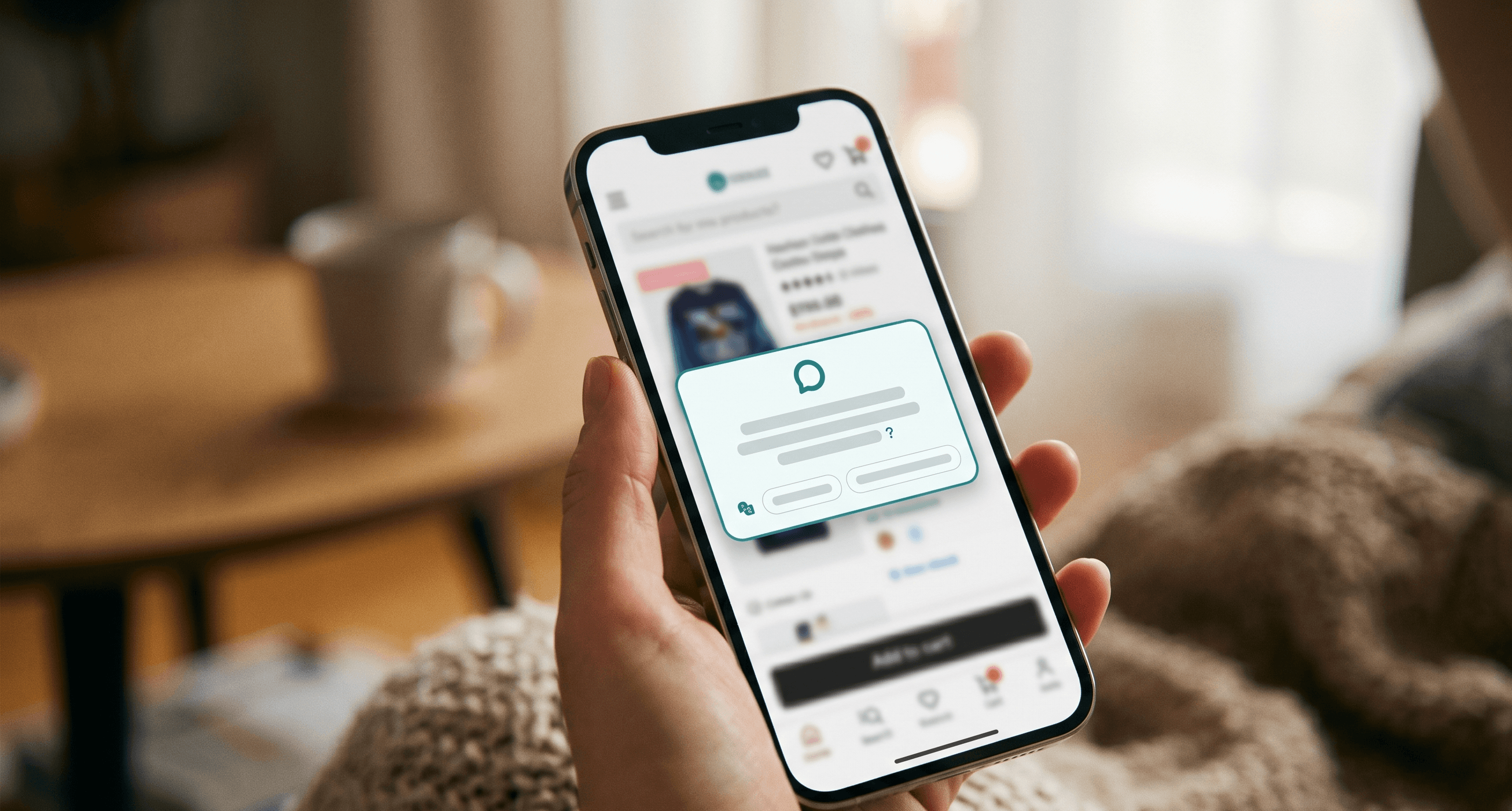
E-commerce chatbots have quietly stopped being a support tool and started becoming a conversion lever. This post breaks down what a modern ecommerce chatbot actually does — recovering abandoned carts, answering pre-purchase questions, surfacing the right product — and why the conversion lift often dwarfs the support savings. If you're still treating chatbots as a cost center, you're leaving the revenue case on the table.
Ecommerce conversion rates have barely moved in a decade. Most stores still convert 1–3% of visitors, and the other 97% leave with questions in their heads — about sizing, shipping, returns, compatibility, materials, stock — that the product page didn't quite answer.
That gap is exactly where AI chatbots earn their keep on an ecommerce site. Not as a generic support tool, but as a sales assistant that lives next to the buy button and answers the question that's actually blocking the purchase.
This is one of the highest-leverage chatbot deployments in 2026, and it's also one of the easiest to get wrong.
What Ecommerce Visitors Are Actually Asking
If you read your live-chat transcripts or your search-bar logs, you'll see the same patterns over and over:
"Will this fit a [specific] [size/device/setup]?"
"How long until I get it?"
"What's the return window?"
"Do you ship to [country]?"
"Is this in stock in [color/size]?"
"What's the difference between [Product A] and [Product B]?"
Most of these are answered somewhere on your site, but the visitor doesn't want to hunt for them. They want the answer in two seconds. If they don't get it, they bounce — and they almost never come back.
A well-trained chatbot turns those questions into answered questions. And answered questions convert dramatically better than unanswered ones.
The Conversion Math
A baseline ecommerce site might see 4–6% of visitors engage a chatbot if it's offered. Of those engaged sessions, conversion rates typically run 1.5–3× the site average. That's not a vanity stat — it's that the people willing to ask a question are higher-intent in the first place, and they're getting their friction removed.
A back-of-envelope model:
Lift revenue = (Sessions engaged × incremental conversion rate × AOV)
On 100,000 monthly visitors with a 5% engagement rate and a 1.5-percentage-point conversion lift on engaged sessions at an $80 AOV, you're looking at about $6,000 of incremental monthly revenue from conversation alone — separate from any support savings. We work through the full ROI picture in the chatbot ROI breakdown.
The lift is highest in three categories: apparel (sizing questions), consumer electronics (compatibility), and high-AOV products (price-justification questions). If you sell in any of those, the conversion case is strong.
What Separates a Sales Chatbot from a Support Chatbot
A support chatbot answers questions. A sales chatbot answers questions and moves the user forward. The difference shows up in a few places:
Product knowledge depth. A sales chatbot needs to know your full catalog — specs, materials, dimensions, compatibility — at the level of detail a product expert would. Generic FAQ-style chatbots fail here. You need proper retrieval-augmented generation over the actual product data, not just a help-center scrape.
Recommendation logic. When a user asks "which one's right for me?" the bot should be able to ask 1–2 clarifying questions and then point at a specific SKU with reasoning. This requires structured product data, not just descriptions.
Gentle nudges, not aggressive pushes. Bad sales bots feel like a pushy salesperson. Good ones feel like a knowledgeable friend. The tone tuning matters more than the model choice.
Handoff for high-AOV moments. When a visitor is mid-conversation about a $4,000 purchase, sometimes the right move is to hand off to a human — fast, with full context. The bot's job there is to qualify the lead and warm the handoff, not to close.
The Common Failure Modes
A few patterns that quietly tank ecommerce chatbot deployments:
1. The bot doesn't know stock or pricing. If your product database isn't connected, the bot will give stale answers and lose trust within a session.
2. Hallucinated specs. A chatbot that confidently invents a TV's HDMI port count is going to generate returns. This is exactly the failure mode covered in why AI chatbots hallucinate, and it's especially dangerous for ecommerce.
3. No handoff logic. Real complaints — damaged orders, delivery issues, fraud — need a human. A bot with no clean escalation path will make these worse.
4. Treating the chatbot like a generic widget. The chatbots that win are tuned to your brand voice, your catalog, your typical customer questions. The ones that lose are dropped in with default settings and never adjusted.
We track which of these failure modes are showing up using the seven KPIs every chatbot team should watch.
Where to Place It on the Page
Placement matters more than people expect:
Product detail pages: high-impact. Most pre-purchase questions live here.
Cart/checkout: high-impact for shipping and return questions, but be careful — anything that distracts from the buy button can hurt.
Category/landing pages: useful for "help me choose" interactions.
Order tracking pages: where post-purchase support lives.
A common mistake is making the chatbot a sticky-corner widget that triggers nowhere in particular. Better deployments customize the opening prompt by page context — "Looking at the X35? I can help with sizing or compatibility."
Why "AI Chatbot vs Live Chat" Isn't the Right Question
For high-volume ecommerce, the real choice isn't whether to use a chatbot — it's how to combine it with humans. The chatbot handles the 90% of questions that are answerable from your existing content, and the human team handles the 10% that need judgment, complaint resolution, or sales finesse. We covered the broader comparison in AI chatbot vs live chat: which converts better?.
The wrong question: "do I want a bot or a human?" The right question: "where exactly does the bot end and the human begin, and how is that transition handled?"
How Solvara Approaches Ecommerce
When Solvara builds a chatbot for an ecommerce store, we ingest the full catalog, the help center, the shipping and returns policies, and any existing FAQ content. We tune the answer logic to be product-aware — the bot doesn't just retrieve text, it understands which SKU the conversation is about. And we wire in clean handoff to your human team for the moments that matter.
Most deployments are live within a week. See the customer-facing product on the website chatbot page, or book a free demo to see what it would look like on your own catalog.
The simplest test: would a knowledgeable human standing next to the product page sell more of it? If yes, a well-trained chatbot can do the same — at a fraction of the cost, 24/7, in every language your customers speak.