Website AI Chatbot
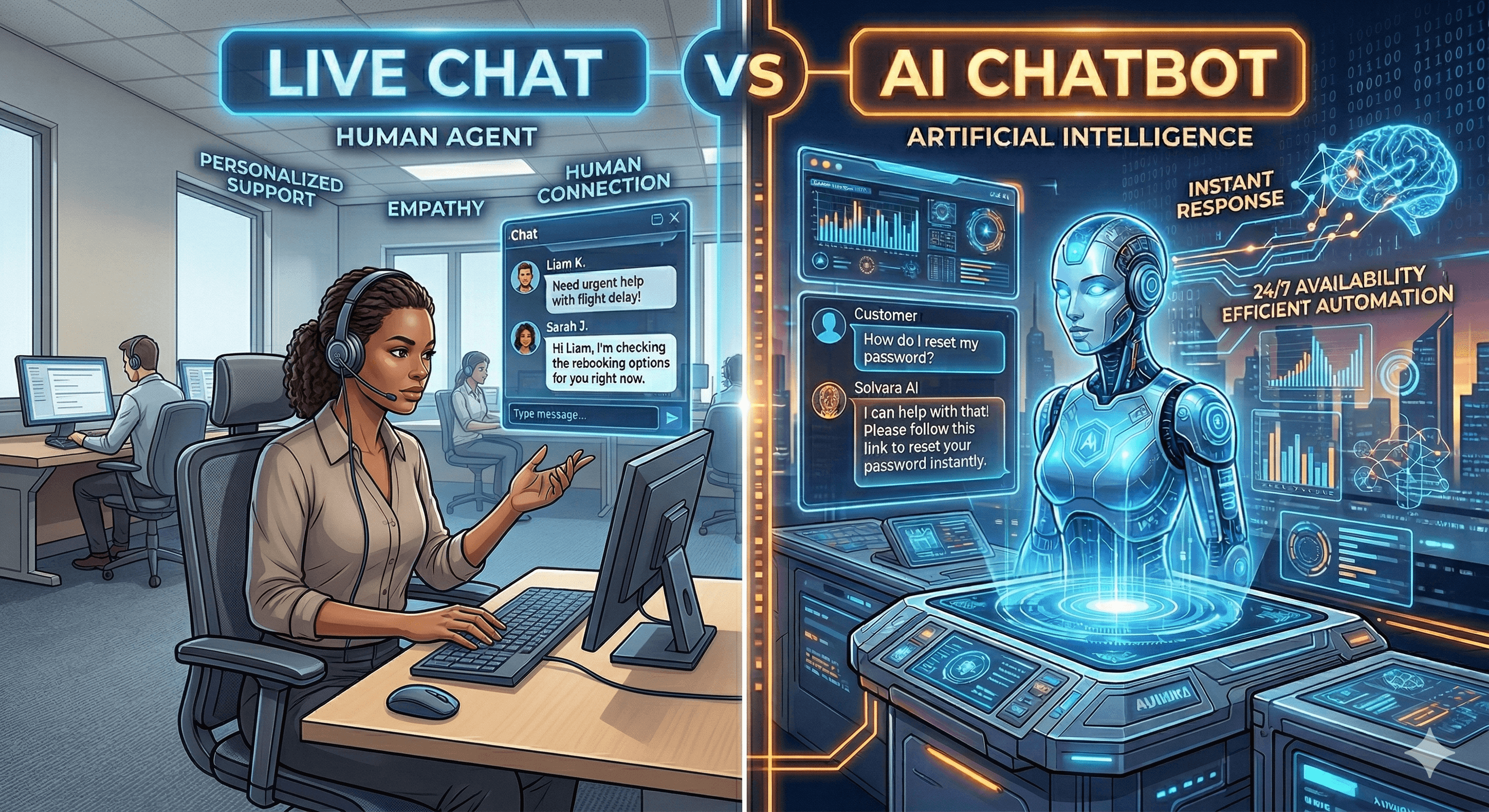
When it comes to converting website visitors into customers, one question comes up often: should you use a chatbot or live chat?
At first glance, live chat feels more personal and reliable, while chatbots are faster and more scalable. But in reality, the difference is not that simple. The real question is not just which one responds better — it’s which one actually helps users get things done.
When it comes to converting website visitors into customers, one question comes up again and again: should you use a chatbot or live chat?
At first glance, the answer seems obvious. Live chat feels more human, more personal, and more trustworthy. Chatbots, on the other hand, are fast, scalable, and always available. But when you look closer, the decision is not that simple.
Both solutions have clear advantages, but they operate very differently. And ultimately, the right choice depends on what you prioritize most: speed, cost, or depth of interaction.
Let’s take a closer look.
What is Live Chat?
Live chat connects users directly with a human agent in real time. It has been a standard tool for customer support and sales teams for years, especially in industries where conversations tend to be more complex or sensitive.
The biggest strength of live chat is its ability to deliver a highly personalized experience. A real person can understand tone, context, and nuance in a way that most systems still struggle to replicate. When a user has a unique problem or needs reassurance before making a decision, human agents can adapt their responses, ask follow-up questions, and guide the conversation naturally.
This level of interaction can build trust. For many users, especially in high-stakes decisions, simply knowing that there is a real person on the other side makes a difference.
However, live chat comes with limitations. It is only as available as your team. Unless you operate a 24/7 support system, there will always be times when users are left waiting — or worse, receive no response at all.
Even during working hours, response times can slow down when agents are handling multiple conversations at once. And as your traffic grows, scaling live chat becomes expensive. More users require more agents, which increases operational costs significantly.
There is also the issue of consistency. Not every agent performs at the same level. Some may fully understand the user’s problem and respond effectively, while others may miss context or provide weaker guidance.
What is a Chatbot?
Chatbots take a completely different approach. Instead of relying on human agents, they use automation to respond to users instantly.
The most obvious advantage is speed. There is no waiting time. Users receive answers immediately, regardless of how many people are interacting with the system. Chatbots are also available 24/7, which removes the limitation of working hours entirely.
From a business perspective, chatbots are also much more cost-effective and scalable. A single system can handle thousands of conversations at the same time without requiring additional staff. This makes them particularly valuable for high-traffic websites.
For users, this often translates into a smoother experience — especially when they are looking for quick answers about products, pricing, or services. In many cases, an instant response can be the difference between a user leaving the site and completing an action.
However, traditional chatbots come with their own challenges. Many of them still struggle with understanding real user intent. Instead of acting like a helpful assistant, they behave more like a static FAQ system. They may provide generic answers, misunderstand the question, or simply not have access to the right information.
This is where frustration builds. While chatbots are fast, they are often not as relevant or personalized as users expect.
So, Which Converts Better?
The honest answer is: it depends on the situation.
Live chat tends to perform better in scenarios where the interaction is complex, nuanced, or requires a human touch. If a user is unsure, comparing options, or dealing with a specific issue, a real person can guide them more effectively.
Chatbots, on the other hand, perform better when speed and efficiency are the priority. When users want quick answers and minimal friction, instant responses often lead to higher conversion rates.
But there is a deeper insight here:
Most users are not looking to “chat” — they are trying to solve something as quickly as possible.
And this is exactly where both traditional approaches start to fall short.
The Problem with Both
Live chat is powerful, but it does not scale easily. It is slower, more expensive, and limited by human availability.
Chatbots are efficient, but often too shallow. They respond quickly, but not always accurately or meaningfully.
As a result, businesses are usually forced to choose between two imperfect options:
a human solution that is personal but slow and costly
or an automated solution that is fast but often generic
There is a clear gap between speed, accuracy, and personalization — and most tools only solve part of the problem.
A Better Approach: Solvara AI
This is where Solvara AI changes the equation.
Instead of acting like a traditional chatbot or trying to replace human interaction entirely, Solvara is built to combine the strengths of both approaches.
Solvara works by scanning and understanding your website and documents in depth. In practice, this means your entire website becomes accessible through a single, simple interface. Users no longer need to search through pages, menus, or links — they can just ask.
More importantly, Solvara does not rely on generic responses. It understands user intent and the underlying problem behind each question. That allows it to generate responses that feel relevant and tailored, rather than scripted or repetitive.
This is what makes it different from most chatbots. It is not just fast — it is also context-aware and personalized.
And beyond answering questions, Solvara focuses on outcomes. Whether it is guiding users to the right product, helping them navigate a process, or enabling them to take the next step, the goal is always the same: help users get things done.
See how it works: https://www.solvara.tech/ai_chatbot
Final Thoughts
The conversation is no longer just about “chatbot vs live chat.”
The real question is:
Can your system actually help users move forward?
Most tools either talk without solving, or solve too slowly.
Solvara bridges that gap.
It is as fast as a chatbot, as relevant as a human interaction, and built to turn conversations into real outcomes.
And ultimately, that is what drives conversions.